Friday, 19 December 2014

Higher Level Stewardship and Golf

Jonathan Wood, Courses Manager at 36-hole Enville Golf Club, discusses the route to securing Higher Level Stewardship for its Lodge and Highgate courses.

In February 2007 as our existing countryside stewardship agreement was drawing to its, conclusion it was suggested that it would be of great benefit to both the golf courses and the course’s environment, if we were to apply for Higher Level Stewardship.

The Natural England representative who was visiting at the time was confident that we would be accepted onto the Higher Level Stewardship scheme due to the level of work recently completed and the sites overall value to the wider countryside.

Environmental Stewardship is a government-funded scheme administered by natural England. It is an agri-environmental scheme, which aims to secure widespread environmental benefits. The scheme has three elements:

  1. Entry level Stewardship
  2. Organic Entry level Stewardship
  3. Higher Level Stewardship.

Entry Level Stewardship is a ‘whole farm scheme’ (farm is used due to the agri bias of the scheme but applies to all open managed land) open to all farmers and other land managers.

The first two levels are fairly self-explanatory, but the Higher-level Stewardship is focused on the more complex and high priority environments and situations. For example, heathland is a high priority as it is of great importance due to its Biodiversity Action Plan. This level requires specific levels of management and specific criteria to be in place before acceptance onto this scheme becomes an option.

In order to be considered for the Higher-level Stewardship, a Farm Environmental Plan (FEP) has to be completed. This plan will identify features and habitats, which will then have specific management plans associated with them for their improvement and long term management which in turn will benefit the environment. This plan is very detailed and as such, pretty time consuming, and needs to be completed with the help of an ecologist to ensure it gives good underpinning knowledge of the specific areas in question.

The plan for Enville Golf Club was carried out by an ecologist from the local Farming and Wildlife Group (FWAG). The ecologist I worked with was very familiar with the requirements of Natural England set out under the Higher-level Stewardship. In the past, landowners have been turned sown due to an insufficient FEP being completed. The cost of the FEP can be partially claimed back upon acceptance onto the Stewardship.

As part of this process, we compiled very detailed plans of the golf courses from ordinance survey maps and the areas of management. These will help in the planning stage and the monitoring of ongoing work; they also give a definitive resource for day-to-day applications.

The FEP was completed over a month and the ecologist worked very closely with myself as the Courses Manager, to make sure all areas of the golf course were visited so that the maximum benefit could be achieved from the Stewardship. As we are a predominately heathland site, the main emphasis centred around these areas. However, the semi ancient woodland and predominately coniferous woodland areas were to figure significantly in the final report and subsequent stewardship.

Other less conspicuous areas were also investigated which in general would not have been part of our existing management. Some of these areas were highlighted due the fact that as part of the FEP an historical survey of the golf courses had to be completed using old council archives to ascertain if there would be any historical features unbeknown to the present management, which could be renovated or improved. This did uncover some interesting historical sites and features. For example, in particular we discovered that in two areas of the courses, there were sites of warrener’s Lodges. These would have been stone dwellings for men employed by the local landowner to maintain and protect the rabbit colonies. Rabbits were the staple diet of most people of wealth and also produced fur for clothing. Around the fourteenth century, Warrener’s were some of the highest paid manorial officials and this would explain the existence of these purpose-built Lodges, which would have been built to very high standards to keep out poachers and people trying to steel the valuable commodity inside. They would invariably have been built on high ground on the open heathland, so as to give the warrener’s the best vantage point to survey their land and to be able to see oncoming danger. The last recoding of these Lodges was in 1623. We have researched these buildings and have found this picture below of what the Lodges would have looked like (Image A).

Although they have no significant interest today, it is good to increase overall knowledge of the history of the site we work on.

The historical survey also revealed two pools sites to the south of the Highgate course. Recordings of these pools date back to 1775, whilst one of the pools still remains today and has recently been renovated and extended. The second pool has dried up and trees have encroached into the area. It is the intention under the agreement that we will reinstate this pool and add another environment to the golf course.

As part of the Stewardship we have been able to complete plans developed with the STRI Ecology team of Bob Taylor and Kelly Harmon to install a reed bed system to reduce the amount of silt and nitrates reaching our pools. The pools are naturally fed from a watercourse which pulls water from the surrounding agricultural land. This was presenting problems with the existing pool in terms of weed and algae infestation. The reed bed system has created another great environment on the golf course site combined with reducing a problem.

One of the key areas under the Stewardship was the facility to claim for capital work items and special items, which would be used to complete the management proposals within the agreement. For instance the special item we claimed for was a new flail collector, which will be used extensively in the preparation of new heathland areas from grassland and also for the ongoing management of the heathland. This machine was eventually partially funded through the agreement.

The FEP, along with our application, was submitted to Natural England in June 2007 and by the beginning of September, we had received the great news that we had been successful with our application. The Stewardship agreement was scheduled to start on the 1st October 2007, so there were a number of meetings with Natural England representatives to finalise some of the finer details, following which we were then ready to start.

During October we were given the official agreement document, which sets out the requirements of the agreement, the amount of area to work on and an outline of the specific management techniques and requirements, along with indicators of success attached to the specific areas of management. The total area covered by the agreement is 100.65 Ha with the total golf courses being 121.4 Ha.

Outlined below are the areas that the agreement covers and a brief outline of indicators of success for their management:

Maintenance of Woodland


  • Tree species Oak/Ash/Field Maple/Beech and Birch should be present at irregular spacing, with overall canopy cover of between 50% and 75% of the area.
  • Cover of shrubs Hazel/Hawthorn/Blackthorn/Holly and Heather should be between 10% and 25%.
  • A network of rides and open ground should cover between 10% and 30% of the area.
  • By year ten of the Scheme, none of the undesirable species of Himalayan Balsam and Poplar, should be more than occasional.

Maintenance of Lowland Heathland


  • Cover of dwarf shrubs, at least two species, should be between 25% and 95%.
  • There should be a wide range of age classes of dwarf shrubs present. This should include between 10% and 15% cover of the pioneer stage, between 25% and 40% cover of the building stage, between 25% and 40% cover of the mature stage, between 10% and 30% cover of the degenerate stage and no more than 10% cover of dead dwarf shrubs.
  • Cover of bare ground should be less than 5% of the land.
  • Cover of Western gorse should be between 2% and 10%.
  • Cover of bryophytes and lichens should be at least 10%.

Restoration of Forestry areas to Lowland Heathland


  • By year five the cover of heather should be between 10% and 50%
  • By year ten the cover of heather should be a mix of at least two of these three species: Calluna Vulgaris, Erica Cinerea and Erica Tetralix.
  • By year ten the cover of common gorse should be between 2% and 10%.
  • By year ten the cover of bare ground should be between 5% and 10%.


Creation of Lowland Heathland from improved Grassland.

  • By year ten the cover of heather should be between 25% and 50% and include two of the three species already mentioned.
  • By year ten the cover of common gorse should be between 2% and 10%.
  • By year five the cover of bare ground should be between 1% and 5%.


We are implementing a wide range of techniques in achieving the above goals which have been trailed and assessed over many years of heather management. The technique of turf stripping has been the most successful and has given us good quality fescue turf for bunker construction and maintenance. We have used the turf to enhance the appearance of new and old bunkers making them blend into the surrounding environment and giving them really character which adds to the feature. We have found within two years the existing seed which has been lying dormant will germinate and start to establish in the turf stripped area within two years. The two pictures below show an area of turf stripping and the soil profile with the turf remaining. Please note the area of dark soil in which the dormant heather seed exists.


Friday, 2 May 2014

From February through to beginning of May

It has been some time since my last post so I will aim to bring you up to date using a number of picture of work completed on the courses along with information to go with them.
Presentation is always high on the agenda and with reasonable conditions during late winter and into spring we have been able to continue with pedestrian mowing of tees and greens, this is still continuing to date. We feel pedestrian mowing although time consuming gives us a better finish and appearance. When conditions and work schedules limit the time available we will go back to ride on mowing but still aim to get the pedestrian mowers out from time to time.
We spend a lot of time setting up mowers correctly especially coming into the growing season, we make sure cut quality is good with regular sharpening and as you can see above making sure the height of cut is correct. We are currently cutting greens at 4mm, this is our regular summer height. During the winter period the greens height is raised to 5.5mm. The summer height of cut for the collars and aprons is 10mm and our fairway summer height of cut is 12mm.

This picture was taken of the 10th Highgate in early April.
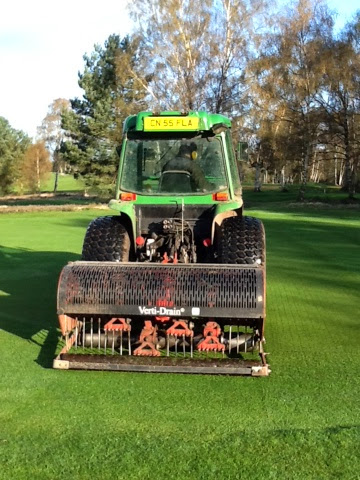
We then completed scheduled aeration work on both courses during April, when we do some deep solid tinning with 12mm tines to a depth of around 8-10 inches followed by some shallow 10mm solid tinning. This aeration compliments our regular in season aeration work of fortnightly 8mm slid tinning and weekly sorrel rolling. We have no need to complete disruptive hollow coring as we do not produce excessive organic matter which has to be removed and as a result can produce good playing surfaces for the majority of the year.
After the aeration work we then top dress and brush in as you can see here. When we do our scheduled spring and autumn aeration we apply in the region of 40 tonnes to the greens to be brushed into the holes. Our target for the year is between 150 and 200 tonnes, in season we top dress every two weeks when possible delivery around 12 tonnes per application. Top dressing is a very important process as it helps to keep the surfaces firm and smooth along with diluting organic matter and improving the drainage capabilities of the root zone. Making the root zone as dry as possible but retaining in the region of 10-15% moisture is the ideal environment to encourage the finer grasses which our management is geared around.
We are still having the odd frosty morning as can be seen here, this frosty Saturday back in April was not too server, the greens were ok but the surrounding areas had a good white frost on them.
Course furniture has also been given a little tidy up as you can see from the picture above with the addition of some nice new logo plaques.
Both course are now beginning to shape up. This picture was taken this morning after some massive rain storms yesterday afternoon, we recorded an inch of rain! 

Friday, 28 February 2014

Course Managers Report
February 2014

The winter period certainly has been very different from last year presenting us with well documented record breaking rainfall totals on a national level. Our weather station recordings show 350mm for the winter period to date (November 2013 through to the end of February 2014), the national recordings show 450mm for the period in the worst effected areas of the country. Along with the effects of the rain we have also suffered a large amount of tree damage through the high winds experienced. In total we have last in the region of 45 trees over the entire site, but the bulk of these have been lost on holes 4-12 on the Lodge Course.

These trees in the main have been cleaned up along with most of the water damage and debris, there are still a number of trees which need to be cleaned up but these are mainly away from the playing line. In one sense this has helped us long term as in most cases a large percentage of the trees were due to be felled as part of our ongoing work with Natural England.

As I mentioned in my email dated the 14th February, through out the winter period and particularly the period after Christmas we have been able to keep a selection of holes open if not all of them. This is down to the management work completed in the past and the ongoing aeration work we complete every year. I have planned that we will complete major drainage work to the 8th and 11th fairways on Highgate prior to next winter to improve the drainage capabilities on these fairways and surrounding areas.

Greens, collars and Aprons

The greens are currently being cut at 5.5mm with pedestrian mowers when possible. Our aim over the coming weeks will be to aerate the playing surfaces as much as possible to negate the negative effect the large volumes of rain has on the soil. The aeration will also help to dry out the surfaces. We have also been able to roll the greens for the first time since December; this will improve playing surfaces by rolling out any imperfections left by the saturated ground.

This time of year we are looking to get down our first feed on all playing surfaces, this is a lawn sand predominately made up of Sulphate of Ammonia which helps to slowly encourage the turf to grow and recover from the winter period. This product also has an acidifying effect helping to take out any moss and discourage the annual meadow grass.

Once this initial feed has gone down we will be looking to start refinement work on the surfaces to get them ready for the spring period. This will include operations such as brushing to stand lateral growth, top dressing to even out surfaces and improve firmness and rolling to maintain trueness without completing mowing.

Fairways

The protection of high wear areas will commence on the 7th fairway Highhgate and 3rd Lodge over the coming weeks and if successful I will aim to try this procedure on other areas. We are slowly coming into a time of year when we can expect recovery from the winter traffic, replacing divots and protecting these sensitive areas will go a long way in improving conditions coming into the spring.

Ongoing renovation and improvement work.

The new 6th tee Lodge has been shaped and is ready for final preparations, once this is complete we can then get the tee turfed and completed.

The drainage improvement on the 11th fairway Highgate is almost complete, this work was not in the planned winter work but during investigation whilst trying to unblock a main outfall we quickly realized we had a number of broken drains. We have dug the broken drains out and replaced with new.

The new path at the 13th tee Highgate is complete and we hope to complete similar work on the 17th Tee Highgate in the coming weeks.

General

The new workshop refit is progressing well: we have started to paint the floor and the new electrics and improved lighting will be completed shortly. The new workshop will give us a safe and clean environment to work on machines and more importantly set up machines ready for use which is so vitally important. Correctly cutting machines for an example leaves the turf looking at its best and in good health, also I have discussed in the past about the importance of height of cut and it is well documented in Agronomists reports that it is fundamentally important to the quality of the turf we are producing. These are only two examples of the need to have good workshop environment but the longevity of machines and the increased resale value are also other major factors.

Over this winter period I have mentioned on many occasions that we have some members who appear to have a total disregard for the protection and condition of the golf courses. Pitch marks not repaired, trolleys taken over white lines and greens and tees are a few examples. Course etiquette should be a high priority and I do believe the majority of members and guest do look after the courses. Can we, when we hold interviews with prospective new members spend a little time explaining what is expected of them from this point of view. I believe we need to address this problem as all the positives we get by keeping the courses open are being negated by a few members.

Jonathan Wood
Course Manager
07977448149
jw@j-wood.co.uk

Friday, 31 January 2014

Golf Course Management
Preventing Course Damage and wear

Given the amount of rain and bad weather we have experienced over the winter period and all things considered, both courses have stood up remarkably well so far. With frequent monitoring of known areas of intense traffic and the use of ropes and hoops we are able to control damage through traffic to a managed level.

As we are fast approaching the spring and the onset of more favorable conditions it would be great if you could help us improve the conditions further especially sensitive areas around greens, tees and fairways, your assistance as members will help enormously in improving conditions going into the spring.

From now until the spring is when the greatest damage can occur, with very little growth and with areas that have had constant traffic on them all winter it is even more important for us all to spread the wear as even as possible. When playing over our courses if you could pay attention to roped off areas and hooped areas and avoid trying to travel through these areas especially close to greens, it would help greatly.

If you could also be extra cautious with your trolley’s particularly around greens and aim to keep well away from the putting surfaces and tee tops, divert around any wet or worn areas on fairways, this would be very much appreciated.

It would also be greatly appreciated if you could make sure you repair your pitch marks and remind your playing partners to do so also. We all want the best putting surfaces we can get and the repairing of pitch marks goes a long way in achieving this.

If we can all work together and hopefully with some improved weather conditions around the corner then we can all look forward to improved conditions in the spring.

Another area that we are looking into is the amount of divots in certain areas of the fairways; one particular problem area is the 7th Highgate. Here the natural contours encourage the majority of drives into one area. To over come this we will be using a mat system where by when you find your ball in a marked area of the 7th fairway you will be obliged to place your ball on a mat provided and play from that mat. This will help to prevent wear at this time of year and aid recovery coming into the spring. This will be used on other areas of the course where needed..

Jonathan Wood
Course Manager
07977448149

Repairing Pitch Marks

Always remember, if your shot hits the green on the fly, there will be an element of damage. Find it, repair it, then look for and repair at least one other that someone else missed. If you notice any ball mark on the green that needs fixing, fix it.
Never take your pull-cart over white lines or across tees or greens, or across the fringe between the green and a greenside bunker. Always move your cart to a spot between the green and next tee before proceeding to the green to putt.

Friday, 17 January 2014

Course Managers January Report


Course Management
Course Manager’s report for January 2014

Annual weather report

Firstly, a belated Happy New Year to you all as we tentatively take a soggy step into 2014!
Before I go onto my report I thought we could have a quick look back at 2013.

The GDD data for 2013 picks out the growth conditions perfectly with a flat start to the year, in essence the grass plant grew better in January than it did in February or March. The winter was long and hard, but in reality it didn’t start until mid-January (be warned).
It wasn’t until mid-April that the weather changed for the better, curiously enough in exactly the same week it changed for the worse in 2012! By July we were flying and enjoyed a heady 3 weeks of hot, dry weather, with Ireland hitting record temperatures.
We had rain in August, kept the good temperature and rolled on into September still tickling along nicely. October was exceptionally mild, with nearly the same growth conditions as September, but with a lot more rain at the end of the month. (Although the rainfall figures for Enville represent one of the driest records for 2013). The temperatures dropped off a cliff in early November as we went into a sustained period of dry, cold conditions. This finished in early December as we picked up milder, westerly winds, but unfortunately these whistled over some intensely deep lows, so the year finished off very windy and very wet.
What an interesting year, but mercifully a better one for most of us after the hard start, though I know a lot of courses were closed over Christmas (and remain so).
So it’s best foot forward into the new year and let’s see what it has in store for the rest of January, however that said we have already experienced over 50mm rain to date in January (2 inches)!

Course restrictions over the last month have been minimal given the volume of rain we have experienced. The Course has been closed on two occasions and temporary greens being used intermittently on specific holes due to either the surround to the green has been waterlogged or the green itself has become too soft for play to commence.

Fine Turf Management

During this stage of the winter it is very much a case of making sure the fine turf surfaces are in as good health as is to be expected at this time of year. If the greens are healthy coming out of the winter, then they will respond well during the spring period.

Management practices employed to create a healthy sward will include timely aeration in terms of slitting, then once we are through January, we use solid pencil tines which are less disruptive to the surface. Regular applications of chelated iron and seaweed help to keep the grass plant healthy and ready for the spring feeding to begin.

We are currently cutting the greens on average once per week at 5.5mm which helps to smooth the surfaces as we are not removing large amounts of grass, however, since December 20th 2013 we have been able to get onto the greens with pedestrian mowers on two occasions and slit aeration in this period has been completed twice also. Rolling will be deployed, when possible given underlying ground conditions, this will help maintain surface levels. During February and if conditions allow, we will give the greens a light top dressing which will signal the start of our spring programme. This early dressing also helps to fill in any scarring caused by disease or pitch marks, and we expect to apply in the region of six tones of material per course with this application.

Renovation and Improvement Projects

Work has progressed well on both courses over the last month with all the planned renovation and improvement projects.

15th Lodge Green Surround and bunkering – All new bunkers are now constructed along with contouring. The turfing will be completed over the coming weeks. We are really pleased with the finished work as it has changed a reasonably bland hole into an interesting and more appealing golf hole.

6th tee Lodge – The constructed of a new tee which was planned for last year will commence during the coming weeks.

13th tee improvements (Highgate) – The new sleeper edge has been installed and the teeing area which was renovated is now ready for turf, which we hope to complete during the week commencing 20th January.

General turf replacement/repairs – We have completed a large amount of repair work around all playing surfaces and this will continue through the majority of February.

The removal of rank grass from around bunkers banks and contouring has also progressed well and this again will continue into next month.

Environmental Management

During periods of weather which restricts the general construction/renovation work, we are able to keep on top of our Stewardship Scheme through Natural England with some important thinning work undertaken as necessary to also sustain good growing conditions for our fine turf surfaces.

The main focus of our thinning work over the coming years will be centered around holes 4-12 on the Lodge course where the long-term aim is to reduce the amount of pine trees and increase the number of indigenous broadleaved trees and to also promote the generation of more heathland within this area.

As you may well be aware, the 4-12 area on Lodge was once a heathland with the heathland being used to plant these pine trees as part of the war effort. This was the case for many heathland areas throughout the country, especially in counties such as Dorset where there were massive areas of heathland demolished with this type of planting. However, that said with heathland being top of the Biodiversity Action Plan and acknowledged as a very valuable resource in terms of wildlife and environment, there are many areas of the country including Enville and Staffordshire, which are actively trying to restore areas of heathland with government funded financial help.

General

We continue to repair lots of pitch marks on the greens on a daily basis, I am aware that the greens have been a little softer than expected due to the persistent rain recently but it remains a problem amongst golfers not repairing pitch marks. In general as I reported at the last meeting general etiquette in terms of repairing pitch marks, adhering to traffic routing and taking an interest in protecting our courses seems to be declining. I will be implementing the protection of fairway areas again this year starting at the beginning of February on selected areas and will also make traffic routing and the protection of areas a priority over the coming months.


Jonathan Wood
Course Manager
Enville Golf Club
07977448149

Monday, 23 December 2013

As I write this post we are experiencing some very wet and windy weather not very seasonal!
We are taking this opportunity when we are limited with the jobs we can complete out the courses to get some much need work completed inside the maintenance facility. Tee balls are beginning painted along with all hazard markers, this will be an ongoing process through the winter period.


We are also continuing getting the new workshop ready by painting the walls.


The area used to be a storage area at the rear of our staff facility, as it is larger and more easily accessed we are making this into our new workshop area. We can then move the grinding units and workshop machinery into this new area.The old workshop will give us an area to store large pieces of machinery such as tractors and aeration equipment.

Over the last two weeks we have been able to strip out a number of areas of rank grass around bunker contouring which made ball retrieval difficult and detratced from the heathland look of wispy fescue grasses. We have also at the same time planted heather into some of the faces giving and even greater natural look, the fecue turf we have used to replace the rank coarse grass has come from our own turf nursery.


The picture above shows the start of the process with all the rank grass removed and the fescue and heather being put into the face and surround.
The picture below shows the job completed, this type of work will continue over the coming weeks. 
The alterations to the 15th Lodge Green surround have also progressed well with the Left hand side of the greens now being shaped and turfed, the front left bunker has been constructed and turf as the picture below shows. Our aim is to finish this project early in the new year.

General maintenance has continued including further slit aeration to the greens,collars and aprons being completed along with pedestrian cutting of greens and raking of bunkers.

I have mentioned on many occasions the importance of tree thinning around playing surfaces to improve air and light penetration onto the plaing surfaces which in turn help create a better environment for the finer grasses to flourish. One other point which is sometimes overlooked is with tree clearing you increase the ability of early morning sun thaw surfaces during frosty conditions, below is a picture of the 4th Green on highgare, a green which we have completed some tree thinning work but from the picture it is clear we need to do more! You can clearly make out the areas of frost behind the tree cover.

Finally I would like to wish you all a very Happy Christmas and a prosperous New year. Thank you for your continuing support.

Friday, 13 December 2013


Over the last three weeks we have experienced some fantastic weather for the time of year, this has enabled us to progress nicely through both our construction/renovation work and our maintenance work. Aeration is avery important part of our management of all the playing surfaces it enables the rootzone dry out and any moisture to peculate through the soil profile easily and most importantly it enables the soil to breath and therefore the turf remains healthy through the winter period. The turf can also send down deeper roots when conditions allow. Over the past month and a half we have managed to slit aerate the greens and collars five times and we will aim to complete this process another two times before the new year.


As i have mentioned in previous post at this time if year it is very important to keep playing surfaces tidy and pedestrian mowing helps in this regard along with gently rolling the surface and producing a better quality of cut. The greens are pedestrian cut as and when needed but we aim for twice during the week at 5.5mm. The tees are cut once every two weeks at 10mm.  


We are now on top of leaf clearing which has taken many hours but thankfully we have seen the back of that process. other jobs completed on the courses have been topping up bunkers with sand and making sure levels are where they should be.


One area we are focusing over this winter is to strip out unwanted coarse grass from around bunker banks and surrounding contouring. We are replacing this coarse grass with finer fescur turf which we grow on our own turf nursery. The finer fescue grass which dominates the heathland site naturally is far easier to retrieve golf balls from and give the authentic natural look to our bunkers. the picture below is the work completed around the 11th Highgate fairway bunker.


Finally another great view this month across the 2nd on the Lodge Course.